
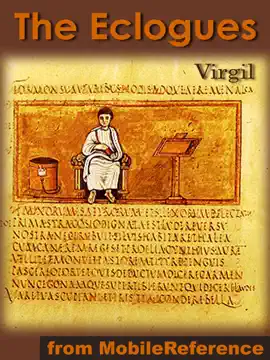
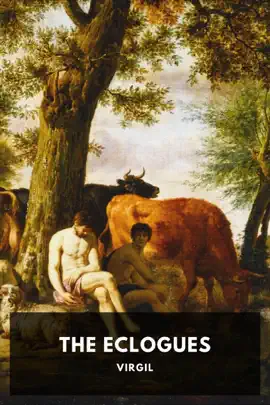
The Eclogues (also called the
Bucolics) are the first of the three major works of the Latin poet
Virgil.
Imitating the Greek Bucolica ("on care of cattle", so named from the
poetry's rustic subjects) by Theocritus, Virgil created a Roman version partly
by offering a dramatic and mythic interpretation of revolutionary change at Rome
in the turbulent period between roughly 44 and 38 BC. Virgil introduced
political clamor largely absent from Theocritus' poems, called idylls ("little
scenes" or "vignettes"), even though erotic turbulence disturbs the "idyllic"
landscapes of Theocritus.
Virgil's book contains ten pieces, each called not an idyll but an eclogue
("draft" or "selection" or "reckoning"), populated by and large with herdsmen
imagined conversing and making songs in largely rural settings, whether
suffering or embracing revolutionary change or happy or unhappy love. Performed
with great success on the Roman stage, they feature a mix of visionary politics
and eroticism that made Virgil a celebrity, legendary in his own lifetime.
— Excerpted from Wikipedia, the free encyclopedia.






![The Complete Harvard Classics 2024 Edition [newly updated]](https://is1-ssl.mzstatic.com/image/thumb/Publication123/v4/50/92/1a/50921a1d-6c1e-aa9c-d2c9-b70c1c5271f0/1021533680.jpg/270x0w.webp)












![The Harvard Classics & Fiction Collection [180 Books]](https://is1-ssl.mzstatic.com/image/thumb/Publication118/v4/c2/72/c3/c272c39b-584c-7029-4ac3-67b7eb3de435/1021523467.jpg/270x0w.webp)




![The Complete Harvard Classics Collection (Golden Deer Classics) [51 Volumes + The Harvard Classic Shelf of Fiction]](https://is1-ssl.mzstatic.com/image/thumb/Publication113/v4/55/66/ac/5566acd8-31cd-0bdb-5f1b-f5f1fcd0ac9c/1020850390.jpg/270x0w.webp)

Explore The Eclogues by Virgil on eBooksStore by Arnlweb. Discover book details, reader ratings, reviews, release information, genres, and related digital books available through the iTunes Store.
This book is part of our growing collection of bestselling eBooks, popular digital reading materials, and trending author releases. Readers can explore similar books, discover new authors, and browse related genres including fiction, romance, mystery, fantasy, business, self-help, educational books, and more.
Our platform helps readers discover highly rated digital books optimized for smartphones, tablets, laptops, and desktop devices. Browse fast-loading book pages, reader reviews, and popular recommendations from bestselling authors worldwide.