
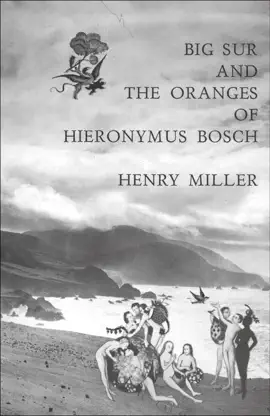
In his great triptych "The Millennium," Bosch used oranges and other fruits to symbolize the delights of Paradise.
In his great triptych “The Millennium,” Bosch used oranges and other fruits to symbolize the delights of Paradise. Whence Henry Miller’s title for this, one of his most appealing books; first published in 1957, it tells the story of Miller’s life on the Big Sur, a section of the California coast where he lived for fifteen years. Big Sur is the portrait of a place—one of the most colorful in the United States—and of the extraordinary people Miller knew there: writers (and writers who did not write), mystics seeking truth in meditation (and the not-so-saintly looking for sex-cults or celebrity), sophisticated children and adult innocents; geniuses, cranks and the unclassifiable, like Conrad Moricand, the “Devil in Paradise” who is one of Miller’s greatest character studies. Henry Miller writes with a buoyancy and brimming energy that are infectious. He has a fine touch for comedy. But this is also a serious book—the testament of a free spirit who has broken through the restraints and clichés of modern life to find within himself his own kind of paradise.






























Explore Big Sur and the Oranges of Hieronymus Bosch by Henry Miller on eBooksStore by Arnlweb. Discover book details, reader ratings, reviews, release information, genres, and related digital books available through the iTunes Store.
This book is part of our growing collection of bestselling eBooks, popular digital reading materials, and trending author releases. Readers can explore similar books, discover new authors, and browse related genres including fiction, romance, mystery, fantasy, business, self-help, educational books, and more.
Our platform helps readers discover highly rated digital books optimized for smartphones, tablets, laptops, and desktop devices. Browse fast-loading book pages, reader reviews, and popular recommendations from bestselling authors worldwide.