
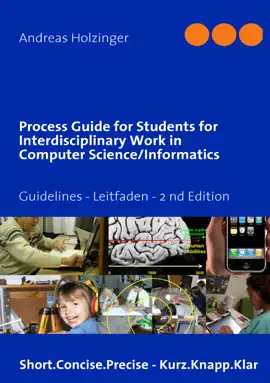
The process of doing an academic work, whether a mini-project, diploma thesis, master’s thesis or PhD thesis, requires systematic knowledge and skills in order to answer the following questions: “How do I find a topic?”, “How do I obtain funding money?”, “How do I write a project proposal?”, “How is the organisatoric workflow?“, “How do I search Literature systematically?”, “Why should I read patents?”, “How can I organize my references?”, “Why English as a working language?”, “What is the formal structure of a thesis like?”, „What is the classical hypothetic-deductive research process?”, „Which research methods could I use?”, “How will my posters, my presentations and my written work be graded?”, “How do I contribute to a conference?”, “How do I contribute to an archival Journal?”. These questions are discussed on the basis of the subjects Engineering (Computer Science/Informatics) and Natural Sciences (Psychology) and Business (Software Engineering/Business), which can be bridged by the subject “Human-Computer Interaction and Usability Engineering (HCI&UE). Since science is trans-cultural, inter-subjective and reproductive; these fundamentals can be further applied to almost any subject.
Die Durchführung einer akademischen Arbeit, ob Mini-Projekt, Diplomarbeit, Masterarbeit oder Doktorarbeit erfordert systematische Kenntnisse und Fertigkeiten um folgende Fragen zu beantworten: „Wie finde ich ein Thema?“, „Wie komme ich zu Förderungen?“, „Wie verfasse ich einen Projektantrag?“, „Wie läuft eine Arbeit organisatorisch ab?“, „Wie führe ich eine systematische Literatursuche durch?“, „Warum sollte ich Patente lesen?“, Wie kann ich meine Literatur verwalten?“, „Warum Englisch als Arbeitssprache?“, „Wie ist der formale Aufbau einer Arbeit?“, „Wie läuft der klassische Forschungsprozess ab?“, „Welche Forschungsmethoden gibt es?“, „Wie werden meine Poster, Vorträge und schriftlichen Arbeiten beurteilt?“, „Wie verfasse ich einen Konferenzbeitrag?“, „Wie verfasse ich einen Beitrag zu einer wissenschaftlichen Zeitschrift?“. Diese Fragen werden exemplarisch an Hand von Ingenieurswissenschaften (Informatik) und Naturwissenschaften (Psychologie) und Wirtschaft (Software Engineering/Business) besprochen, deren Brücke das Fach „Human-Computer Interaction und Usability Engineering“ darstellt. Da Wissenschaft transkulturell, intersubjektiv und reproduzierbar sein soll, lassen sich die Prinzipien aber auch auf andere Gebiete übertragen.








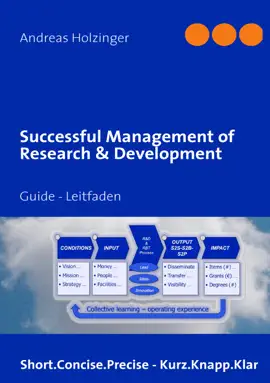











Explore Process Guide for Students for Interdisciplinary Work in Computer Science/Informatics by Andreas Holzinger on eBooksStore by Arnlweb. Discover book details, reader ratings, reviews, release information, genres, and related digital books available through the iTunes Store.
This book is part of our growing collection of bestselling eBooks, popular digital reading materials, and trending author releases. Readers can explore similar books, discover new authors, and browse related genres including fiction, romance, mystery, fantasy, business, self-help, educational books, and more.
Our platform helps readers discover highly rated digital books optimized for smartphones, tablets, laptops, and desktop devices. Browse fast-loading book pages, reader reviews, and popular recommendations from bestselling authors worldwide.