
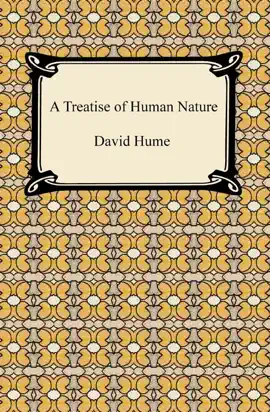
First published in 1739 to an unenthusiastic British public, Hume's "Treatise" has since been referred to as one of the most significant books in the history of philosophy. Hume, a Scottish philosopher, claimed that he was attempting to discuss moral issues with a methodical reasoning, and proceeded to do so in this foundational text. Divided into three large sections, Hume begins his work with a discussion of human understanding, from the origin of our ideas to how we divide them with space and time, with some interesting observations on skepticism. In the second section, Hume speaks of passions, encompassing a range of human emotions and introducing the effect of free will upon them. Finally, the third section covers a variety of moral ideas, including virtues and justice, promises and obligations, and the effect of politics on human morality. Through this treatise, Hume exhibits a remarkable and creative mind, disciplined and enhanced by a systematic method of reasoning, that has produced a text on moral philosophy that continues to stand the test of time over two hundred years later.




![The Complete Harvard Classics 2024 Edition [newly updated]](https://is1-ssl.mzstatic.com/image/thumb/Publication123/v4/50/92/1a/50921a1d-6c1e-aa9c-d2c9-b70c1c5271f0/1021533680.jpg/270x0w.webp)

![The history of England: under the House of Tudor. ... By David Hume, Esq; In two volumes. ... [pt.1]](https://is1-ssl.mzstatic.com/image/thumb/Publication/d2/7d/26/mzi.yvvmfetx.jpg/270x0w.webp)
![The history of England: from the invasion of Julius Cæsar to the accession of Henry VII. ... By David Hume, Esq. [pt.2]](https://is1-ssl.mzstatic.com/image/thumb/Publication/6f/55/c9/mzi.ilnkfiru.jpg/270x0w.webp)

![The history of England: under the House of Tudor. ... By David Hume, Esq; In two volumes. ... [pt.2]](https://is1-ssl.mzstatic.com/image/thumb/Publication/9a/23/c5/mzi.jngzeskn.jpg/270x0w.webp)
![The history of England: from the invasion of Julius Cæsar to the accession of Henry VII. ... By David Hume, Esq. [pt.1]](https://is1-ssl.mzstatic.com/image/thumb/Publication/e8/c7/f9/mzi.vvaygorq.jpg/270x0w.webp)


![A treatise of human nature: being an attempt to introduce the experimental method of reasoning into moral subjects. ... [pt.2]](https://is1-ssl.mzstatic.com/image/thumb/Publication/af/4d/c9/mzi.rcaqrgot.jpg/270x0w.webp)
![A treatise of human nature: being an attempt to introduce the experimental method of reasoning into moral subjects. ... [pt.1]](https://is1-ssl.mzstatic.com/image/thumb/Publication/98/66/2c/mzi.qogkobxh.jpg/270x0w.webp)
![Essays and treatises: on several subjects. By David Hume, Esq; In four volumes. ... [pt.3]](https://is1-ssl.mzstatic.com/image/thumb/Publication/cc/22/e3/mzi.igpwszej.jpg/270x0w.webp)

![A treatise of human nature: being an attempt to introduce the experimental method of reasoning into moral subjects. ... [pt.3]](https://is1-ssl.mzstatic.com/image/thumb/Publication/4a/bf/52/mzi.whfbbsqm.jpg/270x0w.webp)











Explore A Treatise of Human Nature by David Hume on eBooksStore by Arnlweb. Discover book details, reader ratings, reviews, release information, genres, and related digital books available through the iTunes Store.
This book is part of our growing collection of bestselling eBooks, popular digital reading materials, and trending author releases. Readers can explore similar books, discover new authors, and browse related genres including fiction, romance, mystery, fantasy, business, self-help, educational books, and more.
Our platform helps readers discover highly rated digital books optimized for smartphones, tablets, laptops, and desktop devices. Browse fast-loading book pages, reader reviews, and popular recommendations from bestselling authors worldwide.