
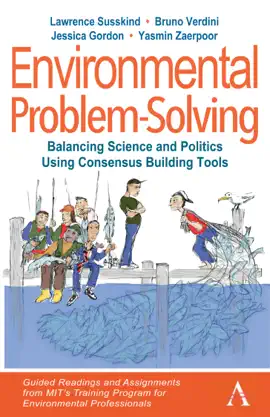
The book is divided into four sections: The first section focuses on how certain environmental problems can only be solved through active government efforts to implement policies that effectively take science and politics into account. This section introduces readers to foundational concepts, including the steps in the US federal environmental policy-making process, and offers an action-oriented analysis of how environmental policy gets implemented and how practitioners can use comparative analysis of public policy in environmental problem-solving. It concludes with questions about the possibility of a unified theory of environmental policy making. The section empowers readers to develop, through carefully designed assignments, a framework to shape an action plan to solve specific environmental problems.
The next section focuses on formulating a sound philosophical basis for taking action in environmental problem-solving situations. This includes a discussion of several ethical frameworks that practitioners can use to underpin the actions they propose. This section begins with a general overview of environmental ethics, and then moves to a discussion of utilitarianism versus intrinsic value, deep green approaches to environmental problem-solving, the debate over sustainability versus economic growth, and how science and indigenous knowledge can be applied in a wide range of environmental problem-solving situations. The section empowers readers to take a stand on these debates, drawing on practical cases with worked examples.
The penultimate section helps environmental practitioners understand how to use various analytical tools. It includes a quick survey of traditional and non-traditional evaluation techniques, discussing the strengths and weaknesses of each, focusing on environmental impact assessment, cost-benefit analysis, ecosystem services analysis, risk assessment, simulation and modeling, and scenario planning. This section prepares readers to practice multi-party environmental problem-solving, and to identify the power of each tool to enhance environmental problem-solving, developing the judgment to enumerate strengths and weaknesses as they see them playing out in practice.
The concluding section is a survey of the theory and practice behind mobilizing support for particular problem-solving efforts. It includes discussions of democratic decision-making and environmental problem solving, how the public can be brought in as a partner, methods of collaborative decision-making, the idea of consensus building, and how politics and power sway collective action efforts.

Explore Environmental Problem-Solving: Balancing Science and Politics Using Consensus Building Tools by Lawrence Susskind, Bruno Verdini, Jessica Gordon & Yasmin Zaerpoor on eBooksStore by Arnlweb. Discover book details, reader ratings, reviews, release information, genres, and related digital books available through the iTunes Store.
This book is part of our growing collection of bestselling eBooks, popular digital reading materials, and trending author releases. Readers can explore similar books, discover new authors, and browse related genres including fiction, romance, mystery, fantasy, business, self-help, educational books, and more.
Our platform helps readers discover highly rated digital books optimized for smartphones, tablets, laptops, and desktop devices. Browse fast-loading book pages, reader reviews, and popular recommendations from bestselling authors worldwide.