
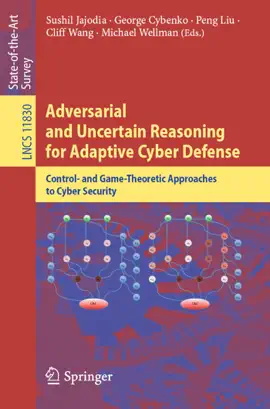
Today’s cyber defenses are largely static allowing adversaries to pre-plan their attacks. In response to this situation, researchers have started to investigate various methods that make networked information systems less homogeneous and less predictable by engineering systems that have homogeneous functionalities but randomized manifestations.
The 10 papers included in this State-of-the Art Survey present recent advances made by a large team of researchers working on the same US Department of Defense Multidisciplinary University Research Initiative (MURI) project during 2013-2019. This project has developed a new class of technologies called Adaptive Cyber Defense (ACD) by building on two active but heretofore separate research areas: Adaptation Techniques (AT) and Adversarial Reasoning (AR). AT methods introduce diversity and uncertainty into networks, applications, and hosts. AR combines machine learning, behavioral science, operations research, control theory, and game theory to address the goal of computing effective strategies in dynamic, adversarial environments.





Explore Adversarial and Uncertain Reasoning for Adaptive Cyber Defense by Sushil Jajodia, George Cybenko, Peng Liu, Cliff Wang & Michael Wellman on eBooksStore by Arnlweb. Discover book details, reader ratings, reviews, release information, genres, and related digital books available through the iTunes Store.
This book is part of our growing collection of bestselling eBooks, popular digital reading materials, and trending author releases. Readers can explore similar books, discover new authors, and browse related genres including fiction, romance, mystery, fantasy, business, self-help, educational books, and more.
Our platform helps readers discover highly rated digital books optimized for smartphones, tablets, laptops, and desktop devices. Browse fast-loading book pages, reader reviews, and popular recommendations from bestselling authors worldwide.